------------------------------------------------------------------ The northern mountain is hidden in white cloud, A happy place for hermits to retire. So we can meet, I try to climb the heights, My heart is fading like a goose in flight. My sorrow's prompted by the creeping dusk, But then clear autumn spurs on my desires. At length we see the villagers return, They walk the sand and rest at the river crossing. The trees against the sky are like shepherd's purse , An islet by the shore just like the moon. I hope you have some wine to celebrate, We'll spend the autumn festival drunk together. --Meng Hoaran Climbing Orchid Mountain on an Autumn Day
Sooner or later in every talk, (David) Brower describes the creation of the world. He invites his listeners to consider the six days of Genesis as a figure of speech for what has in fact been four billion years. On this scale,
a day equals something like
six hundred and sixty-six million years, and thus all day Monday and until Tuesday noon, creation was busy getting the earth going. Life began Tuesday noon, and the beautiful organic wholeness of it developed over the next four days. At 4pm Saturday, the big reptiles came on. Five hours later, when the redwoods appeared, there were no more big reptiles. At three minutes before midnight, man appeared.
At one-fourth of a second before midnight, Christ arrived. At one-fortieth of a second before midnight, the Industrial Revolution began. We are surrounded with people who think that what we have been doing for that one-fortieth of a second can go on indefinitely.
They are considered normal, but they are stark, raving mad.
--John McPhee Encounters With The Archdruid
No, you don't understand, naturally said the second swallow. First, we feel it stirring within us, a sweet unrest; then back come the recollections one by one, like homing pigeons. They flutter through our dreams at night, they fly with us in our wheelings and circlings by day. We hunger to inquire of each other, to compare notes and assure ourselves that it was all really true, as one by one the scents and sounds and names of long-forgotten places come gradually back and beckon to us.
I tried stopping one year, said the third swallow. I had grown so fond of the place that when the time came I hung back and let the others go on without me. For a few weeks it was all well enough, but afterwards, O the weary length of the nights! The shivering, sunless days! The air so clammy and chill, and not an insect in an acre of it! No, it was no good; my courage broke down, and one cold, stormy night I took wing, flying well inland on account of the strong easterly gales. It was snowing hard as I beat through the passes of the great mountains, and I had a stiff fight to win through; but never shall I forget the blissful feeling of the hot sun again on my back as I sped down to the lakes that lay so blue and placid below me, and the taste of my first fat insect. The past was like a bad dream; the future was all happy holiday.
Clash: Armagideon Time Clash: Justice Tonight / Kick It Over
No one believes more firmly than Comrade Napoleon
that all animals are equal. He would be only too happy
to let you make your decisions for yourselves.
But sometimes you might make the wrong decisions, comrades,
and then where should we be?
--George Orwell Animal Farm
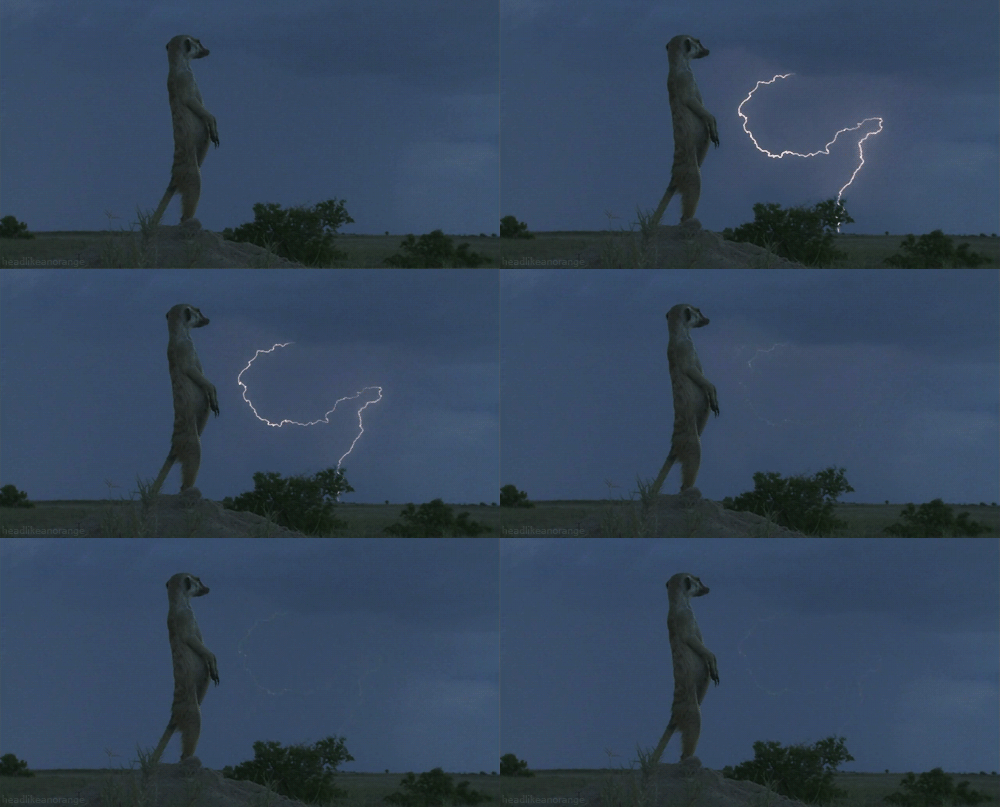
Every fortune-teller I ever met was a faker.
First thing you should do to a soothsayer
is poke them in the eye and say, Didn’t see that coming, did you?
--Mark Lawrence
Yet could anything
be more obvious
than that the past
follows from the present
like a comet's tail,
and that if we are
to be alive at all,
here is the place to be?
Yes Siddhartha, he said. Is this what you mean:
that the river is in
all places at once,
at its source and
where it flows
into the sea,
at the waterfall,
at the ferry,
at the rapids,
in the ocean,
in the mountains,
everywhere at once,
so for the river there is
only the present moment
and not the shadow
of the future?
It is, Siddhartha said. And once I learned this
I considered my life,
and it too was a river,
and the boy Siddhartha
was separated from
the man Siddhartha
and the graybeard Siddhartha
only by shadows,
not by real things.
Nothing was, nothing will be;
everything is,
everything has being
and presence.
--Hermann Hesse
COTTONWOOD CANYON
CHEYAVA FALLS GCNP : ROARING SPRINGS
ROYAL ARCH CREEK
LOWER RIBBON FALLS
ELVES CHASM
i wanna tell you
about texas radio
and the big beat
it comes out of
the virginia swamps
cool and slow
with a back beat
narrow and
hard to master
some call it heavenly
in it's brilliance
others, mean and rueful
of the western dream
i love the friends
i have gathered together
on this thin raft
we have constructed
pyramids in honor
of our escaping
for this is the land
where the pharaoh died
children, the river
contains specimens
the voices of
singing women
call us from
the far shore
and they are saying
"forget the night
live with us
in forests of azure"
meagre food for
souls forgot
i tell you this:
no eternal reward
will forgive us now
for wasting the dawn
and one morning
you awoke to
a strange sun
and opening your door....
---------------------------------------------------------------
Tower of Ra and Shiva Temple
outside Palisade Canyon Doors: "Texas Radio and the Big Beat" "Love Me Two Times"
Dana Butte from Utah Flats
Hermit Canyon
A man was running running for his life, across and up a naked dome of golden sandstone. Far off in silhouette against an evening sky, dark figure running across a field of gold, a flash of gashed vermillion, the flaring fanned-out rays of setting sun peering for one final moment, under a reef of purple clouds, into the slickrock desert, over the rippled sea of golden, lifeless petrified dunes of sand... He ran, ran to live, up the rising skyline curve of rock, across the huge plasmic crimson bulge of sun, black running human animal caught forever, in perpetual motion, eternal in his fear, upon the red sun and background of the yellow sky. A stocky man in boots, jeans, no shirt, big hat, puffing like an engine, hoarse and gasping in despair, laboring at ever-slower pace up the barren and unsheltering incline of monolithic stone.
He ran because he was pursued. Fifty yards to his rear and gaining rapidly came a snorting ramping bellowing machine, the diesel-powered forty-ton dirt scooper, product of Caterpillar Inc., bouncing after its prey on rubber-tired wheels each taller than a tall man. The operator's cab projected forward above the front wheels; the windows of the cab, covered with dust, spattered with mud, obscured the nature of whatever it was, if anything, that guided and propelled and animated the machine. Reaching the upward slope, the machine redoubled its efforts, bounding ahead. Puffs of black smoke jetted from the upright exhaust stack, floating like little balls of dirty cotton up and backward on the pure golden backdrop of the sky. Hopeless flight, implacable pursuit. The running man stopped running, stopped climbing, stopped and turned to face the iron black joggling goblin that approached him, closer, closer, with spinning wheels and howling motor, towering above him, about to run him down, crush him like an insect, leave him smeared in a paste of hair, calcium, protoplasm and blood across the gritty surface of the rock.
The man drew a small object from his belt, something not much bigger than his fist, dark against the sunset light, impossible to immediately identify. The man raised this object and pointed it toward the blunt flat advancing snout of the machine. His finger twitched. A red flame leaped from the tip of the object in the man's hand. Leaped and disappeared, followed presently by the report of a small compact explosion. The man froze, waiting. The machine slowed, stopped as if surprised, and jiggled for a moment, up and down, on heavy springs, twelve feet short of its victim. An arc of cooling liquid spurted like blood from the creature's nose, spouting under pressure into the air then looping down to spatter on the stone. Hurt, baffled, astonished, the machine remained at a standstill, one dark and solid silhouette of steel, rubber, glass and iron upon the forlorn red flare of dying sun, a complicated outline of angles, joints, hoses, couplings, wheels and linkage rods flat black against the horizon. As the light faded the engine died, the coolant drooped in a smaller arc and petered out, the surrounding sea of desert silence closed in complete upon machine and man. Silence. Stasis. Creeping darkness. The man replaced the object in his belt. He turned away from the stricken machine--dead tech--and walked upward on the ridgeline, descended the farther slope and vanished into a dense violet twilight.
We heard him singing. Singing, that is, as a wolf sings, a proud prolonged profound Promethean howl of triumph and joy, a hymn that dwindled after a time to the faintest vulpine vibration on the air but never died, never died completely. New moon. New moon and evening star. The new moon, signal of hope, glowed in the western sky. Quite near, almost within the moon's embrace, hung Venus planet of love, rare as radium pure as platinum more precious than gold.
--Edward Abbey
from Hayduke Lives!
That time of year thou mayst in me behold When yellow leaves, or none, or few, do hang Upon those boughs which shake against the cold, Bare ruined choirs, where late the sweet birds sang. In me thou see'st the twilight of such day As after sunset fadeth in the west, Which by and by black night doth take away, Death's second self, that seals up all in rest. In me thou see'st the glowing of such fire That on the ashes of his youth doth lie, As the deathbed whereon it must expire Consumed with that which it was nourished by. This thou perceivest, which makes thy love more strong, To love that well which thou must leave ere long.
--William Shakespeare Sonnet 73
And if you wish to receive of the ancient city an impression with which the modern one can no longer furnish you, climb--on the morning of some grand festival, beneath the rising sun of Easter or of Pentecost--climb upon some elevated point, whence you command the entire capital; and be present at the wakening of the chimes. Behold, at a signal given from heaven, for it is the sun which gives it, all those churches quiver simultaneously. First come scattered strokes, running from one church to another, as when musicians give warning that they are about to begin. Then, all at once, behold!--for it seems at times, as though the ear also possessed a sight of its own,--behold, rising from each bell tower, something like a column of sound, a cloud of harmony. First, the vibration of each bell mounts straight upwards, pure and, so to speak, isolated from the others, into the splendid morning sky; then, little by little, as they swell they melt together, mingle, are lost in each other, and amalgamate in a magnificent concert. It is no longer anything but a mass of sonorous vibrations incessantly sent forth from the numerous belfries; floats, undulates, bounds, whirls over the city, and prolongs far beyond the horizon the deafening circle of its oscillations.
Nevertheless, this sea of harmony is not a chaos; great and profound as it is, it has not lost its transparency; you behold the windings of each group of notes which escapes from the belfries.
In the morning they came up out of the ravine and took to the road again. He'd carved the boy a flute from a piece of roadside cane and he took it from his coat and gave it to him. The boy took it wordlessly. After a while he fell back and after a while the man could hear him playing.
A formless music for the age to come. Or perhaps the last music on earth called up from out of the ashes of its ruin. The man turned and looked back at him. He was lost in concentration. The man thought he seemed some sad
and solitary changeling child
announcing the arrival of a traveling spectacle in shire and village who does not know that behind him the players have all been carried off by wolves.
--Cormac McCarthy The Road
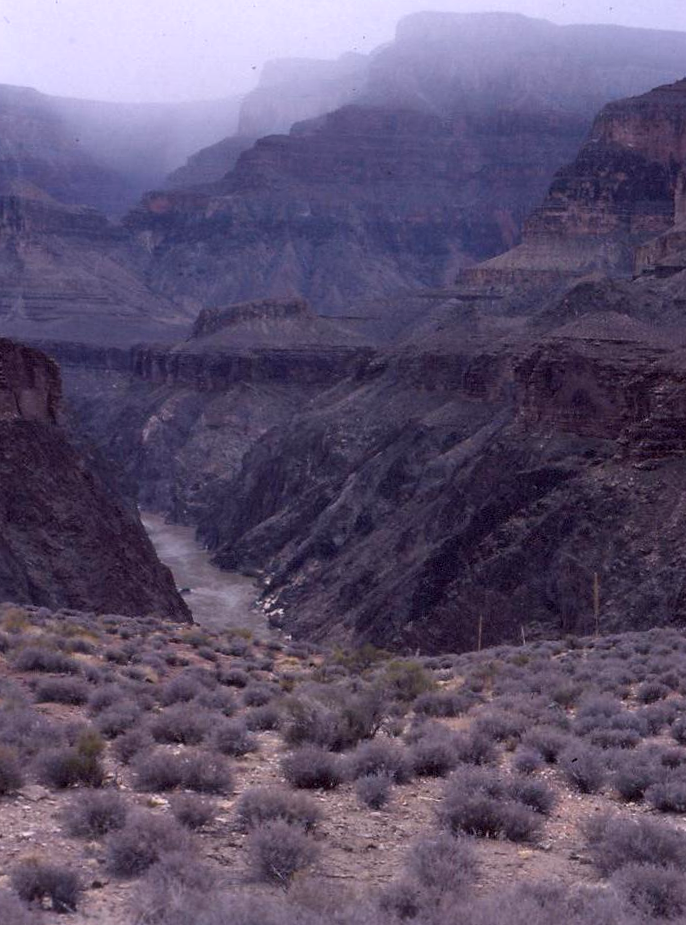
Colorado River below Garnet Canyon
Palisades of the Desert from outside Tanner Canyon
Mendelssohn: "Song Without Words" (Jacqueline du Pré)
Inner Gorge outside Trinity Canyon
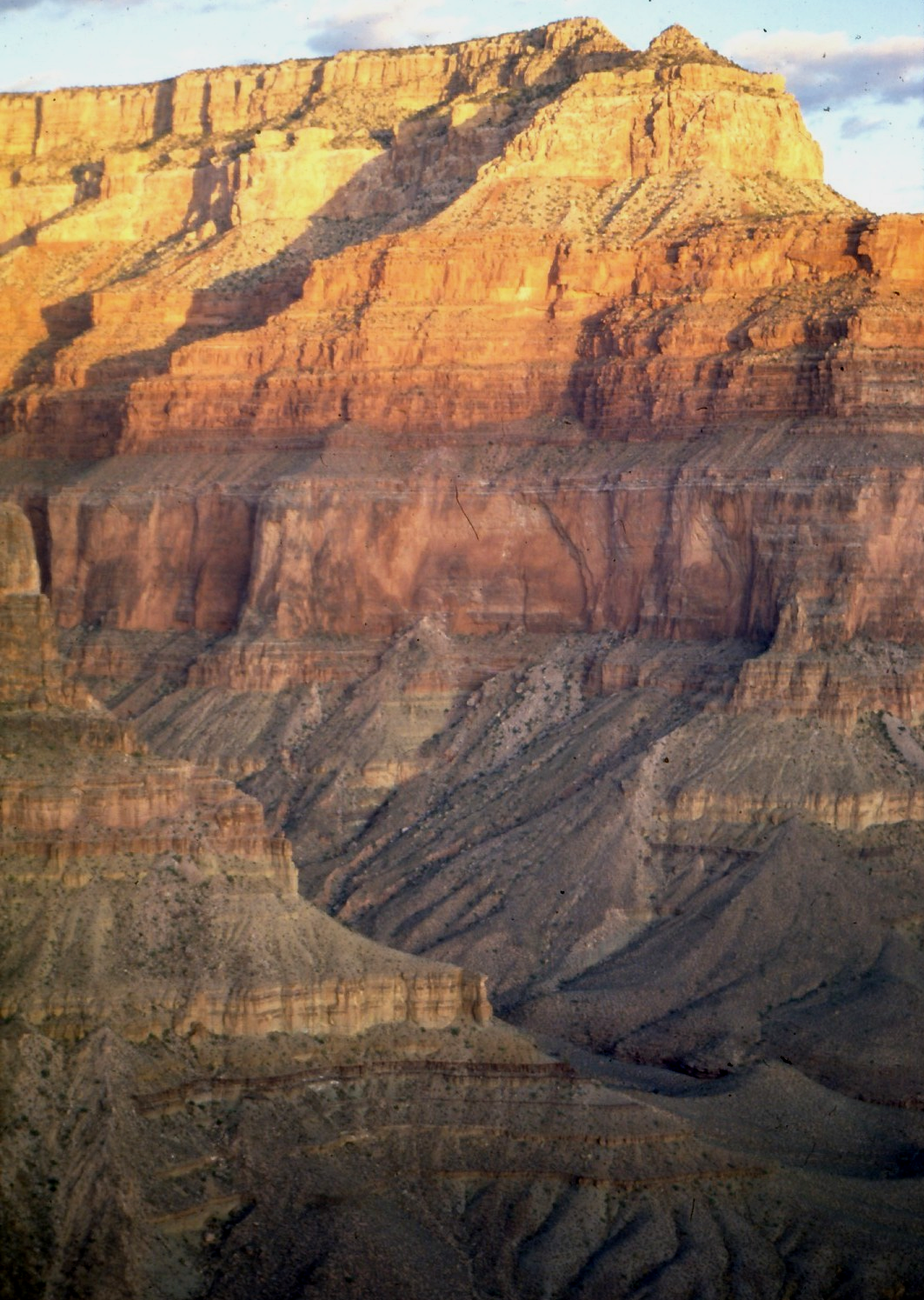
Mencius and Confucius Temples from Whites Butte
Buddha Temple with nomad encampment